Kinetisys
Real-Time AI Insights for Robotic Operations
Detects anomalies, classifies 25 fault types, and explains what went wrong — in plain language — so engineers can act fast.
The Problem
Assembly failures are hard to catch — and harder to explain
When a screw-driving robot fails — an under-torqued fastener, a stripped thread — the root cause is buried in raw sensor data that engineers don't have time to parse manually.
Engineers manually sift through torque-angle curves to find anomalies, delaying corrective action on the line.
Raw sensor streams encode rich fault information, but extracting interpretable features requires domain expertise most teams lack.
Traditional monitoring flags failures without explaining why — leaving operators with an alert and no guidance.
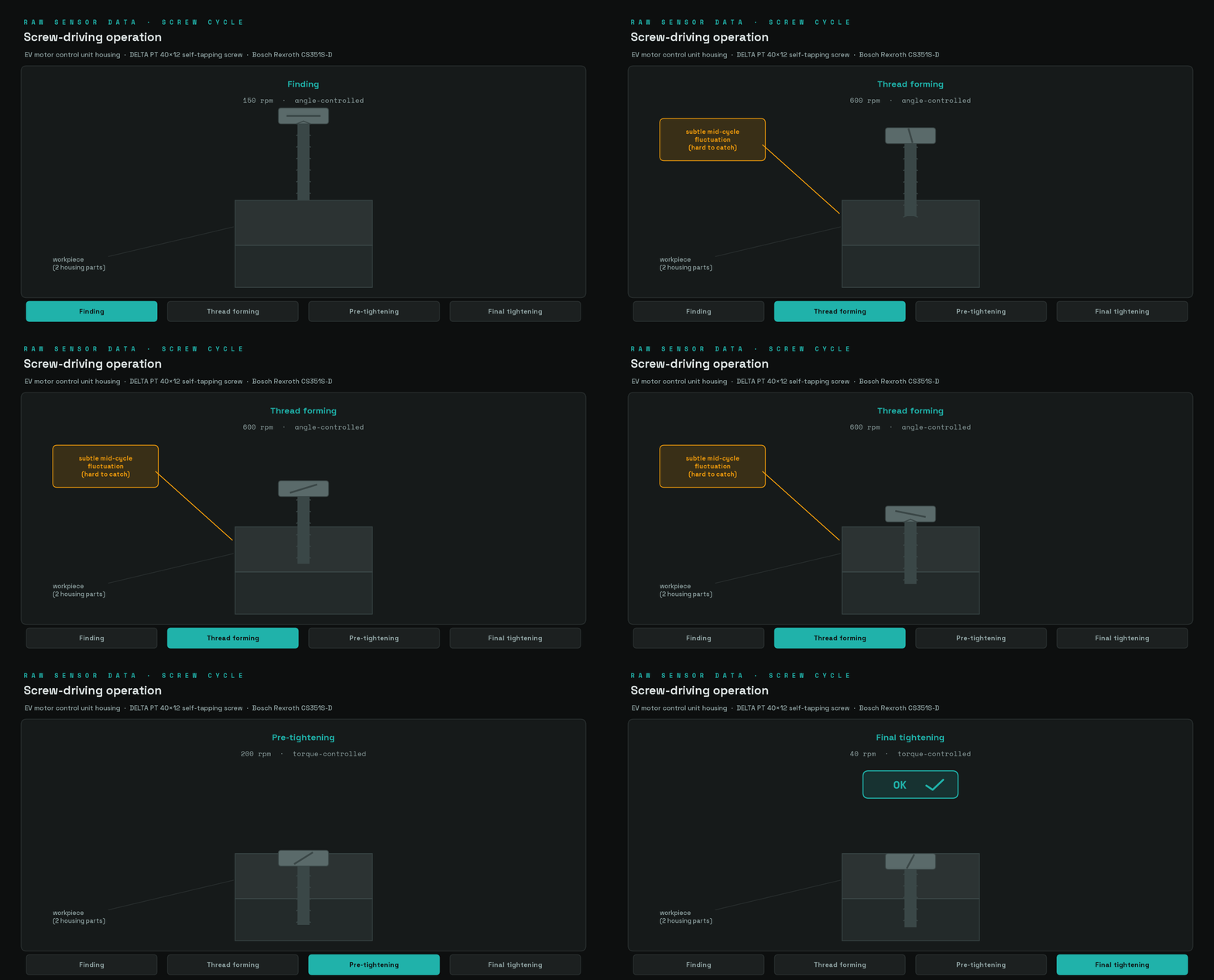
Animated view of the screw-driving sequence used to ground failure analysis before users dive into model outputs.
How It Works
From raw sensor data to actionable insight
A four-stage pipeline transforms screw-driving sensor data into clear triage decisions — from ingestion through grounded AI explanation.
PyScrew s04 dataset loaded via a configurable pipeline — handling duplicates, interpolating gaps, and standardizing sequence lengths.
PyScrew · Pandas · NumPyPhase-by-phase statistical features extracted from torque, angle, and gradient signals across all four screw phases.
sklearn · Phase segmentationXGBoost and Random Forest models handle binary OK/NOK detection and 25-class fault identification, with SHAP explaining each prediction.
XGBoost · RF · SHAPEngineers select any NOK event, review its torque-angle chart, and ask plain-language questions via a RAG chat layer.
FastAPI · RAG · Chart.jsKey Features
Built for the operations engineer
Ask "What went wrong?" — get a real answer
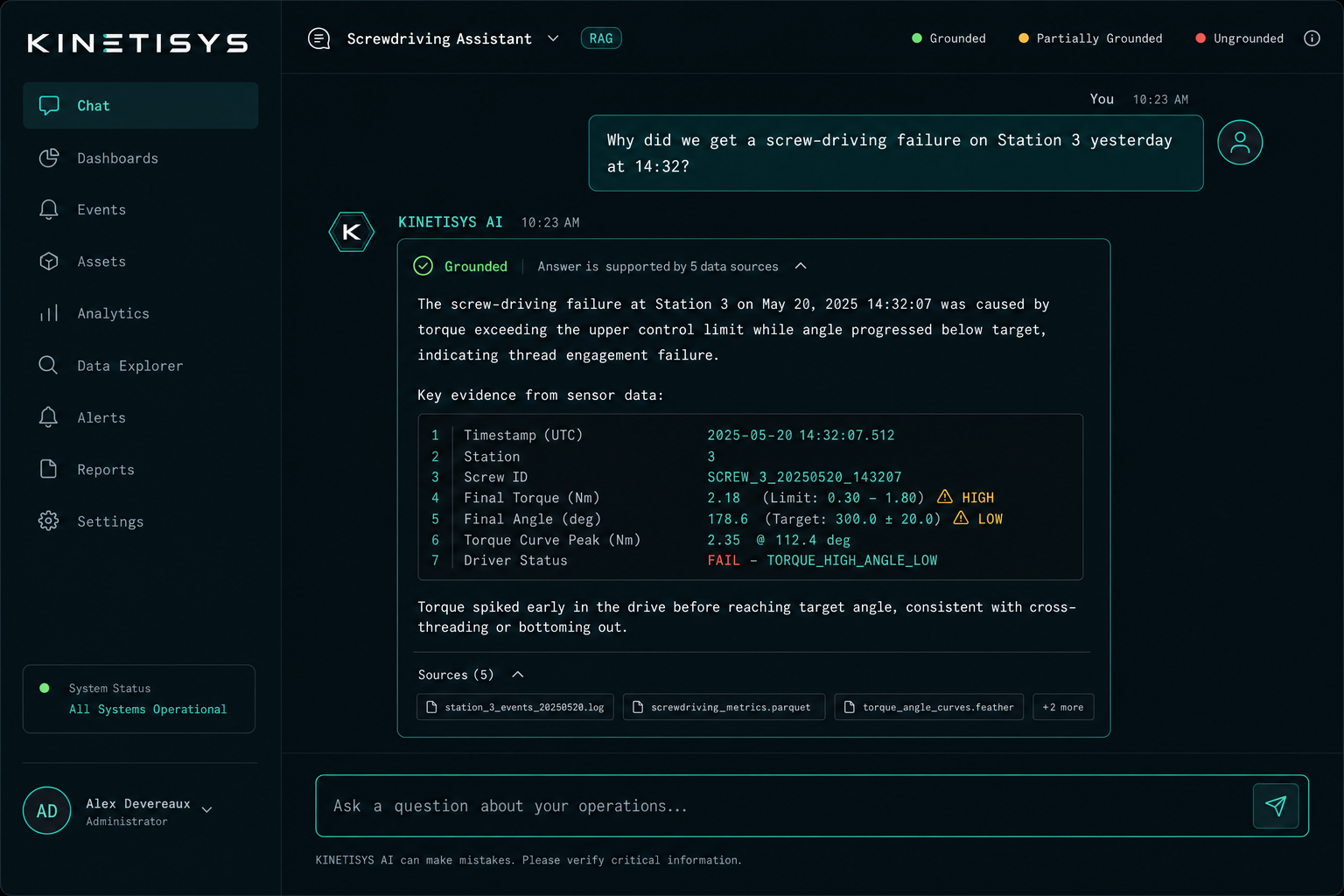
The grounded RAG Q&A layer lets engineers query any failure event in natural language. Responses are anchored to actual sensor evidence — not hallucinated — so operators can trust the explanation and act immediately.
- Cites specific torque/angle evidence from the flagged cycle
- Suggests next diagnostic steps based on fault class
- Provides context from historical similar NOK events
OK / NOK Detection
XGBoost and Random Forest models compete on binary fault detection using workpiece-grouped cross-validation, producing an anomaly score for every cycle.
- ROC-AUC evaluated on out-of-fold predictions
- Class-balanced training handles real-world imbalance
- Grouped split prevents screw-pair data leakage
25 Fault Types, Ranked by SHAP
Each NOK event is classified into one of 25 fault categories — stripped threads, wrong conditions, misalignment — with SHAP scores highlighting the top contributing sensor features.
- XGBoost multi:softprob for calibrated probabilities
- SHAP TreeExplainer for global + per-event attribution
- Top features surfaced directly in the triage UI
Technical Architecture
Built end-to-end with production-ready tools
The Dataset
PyScrew s04 — Industrial Assembly Scenarios
The PyScrew s04 dataset captures real screw-driving operations under 25 assembly conditions — from nominal runs to stripped threads, wrong materials, and fault injections. Each cycle records torque, angle, time, and gradient at millisecond resolution across four fastening phases.
Each screw run is stored as a ScrewRun → ScrewStep → Measurements hierarchy, converted to structured CSV via a configurable PyScrew pipeline before feature extraction and modeling.
25 assembly condition variants, including normal and faulty states
Torque · Angle · Gradient · Time — per-step, per-cycle
Finding · Thread-forming · Pre-tightening · Final tightening
Binary + 25-class labels with workpiece location and usage metadata
The Team
UC Berkeley MIDS · Capstone Summer 2026
A multidisciplinary team from the UC Berkeley Master of Information and Data Science program, combining expertise in machine learning, software engineering, and industrial data systems.


Open Source
Explore the code, data, and models
Everything — from the PyScrew pipeline to the FastAPI backend and Alpine.js triage UI — is available on GitHub. Contributions and questions welcome.